Best Non GamStop Casino UK 2026
Loading...
Every game has its language, and roulette speaks with particular fluency. Walk up to any table—physical or digital—and you’ll hear terms that sound vaguely French, oddly mathematical, and occasionally theatrical. Understanding this vocabulary isn’t mere pedantry; it’s practical. When a croupier announces “rien ne va plus” and you’re still fumbling chips onto the layout, the language gap becomes expensive.
This glossary covers essential roulette terminology from wheel mechanics to betting systems. Whether you’re playing at non-GamStop casinos or anywhere else, these terms remain universal. The wheel doesn’t care about licensing jurisdiction, and neither does its vocabulary.
Wheel and Table Components
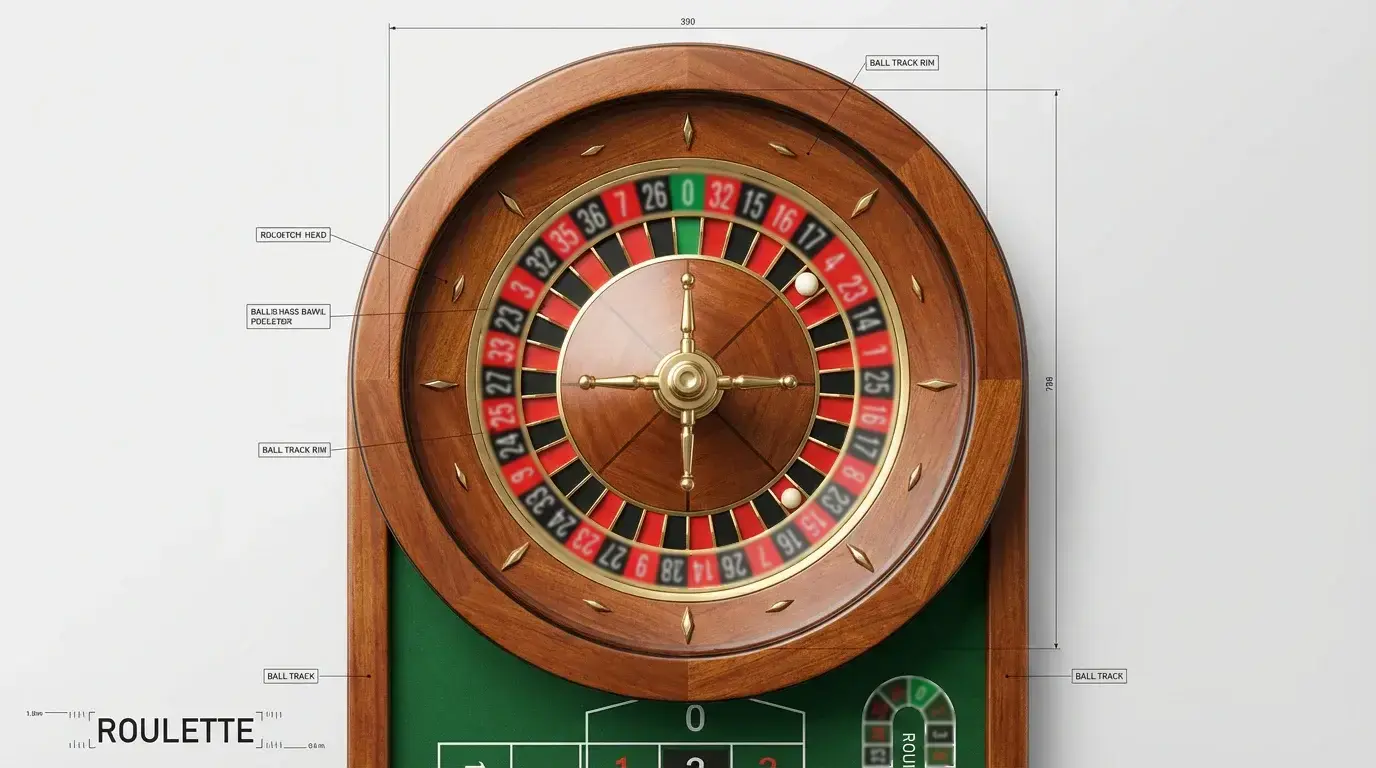
Wheel Head — The rotating portion of the roulette wheel containing the numbered pockets. European wheels have 37 pockets (0-36), American wheels have 38 (adding 00). The wheel head sits within the bowl and spins independently of the ball track.
Ball Track — The outer rim where the ball initially travels before descending toward the pockets. Also called the backtrack. The ball loses momentum here before dropping onto the wheel head.
Frets (Separators) — The metal dividers between numbered pockets. Their height and angle affect how the ball settles. Worn frets can create biased wheels—though modern casinos monitor this carefully.
Dolly — The marker placed by the dealer on the winning number after each spin. No bets may be placed or removed while the dolly is on the table. Touching chips under or near the dolly is a serious breach of etiquette.
Layout — The felt betting surface displaying all possible wagers. The layout shows individual numbers, grouped betting areas (dozens, columns), and outside bet sections. European and French layouts differ slightly in design.
Chip Rack — Where the dealer stores colour chips and cash chips. At busy tables, this becomes a small orchestra of organised chaos.
Drop Box — The locked container beneath the table where cash and large denomination chips are deposited. What goes in doesn’t come out until the count.
Bet Types and Wager Terminology
Inside Bets — Wagers placed on specific numbers or small groups of numbers within the numbered grid. Higher risk, higher payout. Includes straight-up, split, street, corner, and line bets.
Outside Bets — Wagers placed in the boxes surrounding the number grid: red/black, odd/even, high/low, dozens, and columns. Lower payouts, better odds of winning. These are the bread-and-butter bets for conservative players.
Straight-Up — A bet on a single number. Pays 35:1. The glamour bet—dramatic when it hits, quietly devastating when it doesn’t.
Split — A bet on two adjacent numbers, chip placed on the line between them. Pays 17:1. Covers your neighbour without full commitment.
Street — A bet on three numbers in a horizontal row. Chip placed on the outer edge of the row. Pays 11:1.
Corner (Square) — A bet on four numbers meeting at a corner. Chip placed on the intersection. Pays 8:1. Also called a “square bet” or “quad.”
Line (Six-Line) — A bet on six numbers across two adjacent rows. Chip placed on the outer corner where the rows meet. Pays 5:1.
Dozen — A bet on twelve consecutive numbers: first dozen (1-12), second dozen (13-24), or third dozen (25-36). Pays 2:1.
Column — A bet on twelve numbers in a vertical column on the layout. Pays 2:1. Three columns available, each containing different numbers.
Even-Money Bets — Red/black, odd/even, high (19-36)/low (1-18). Pay 1:1. Cover nearly half the numbers but lose to zero.
Call Bet (Announced Bet) — A verbal bet declared by the player and covered by the dealer. Common in European casinos where chip placement would be awkward for certain sector bets. The player calls the bet and becomes responsible for the amount regardless of chip placement.
Five-Number Bet — American roulette exclusive. Covers 0, 00, 1, 2, and 3. Pays 6:1 but carries a 7.89% house edge—the worst bet on the table. Experienced players avoid it entirely.
Croupier and Dealer Terms
Croupier — The casino employee who operates the roulette table. Spins the wheel, releases the ball, announces results, collects losing bets, and pays winners. The term is French and traditional; “dealer” is acceptable but less precise.
No More Bets — The English equivalent of “rien ne va plus.” Announced when the ball begins to slow and no further wagers will be accepted. Placing chips after this call is void.
Spin — One complete game cycle: bets placed, ball spun, result determined, payouts made. Also called a “coup” in traditional usage.
Clearing the Table — The process of collecting losing bets and removing them from the layout after each spin. Happens before winning bets are paid.
Colour Up — Exchanging smaller denomination chips for larger ones. Players colour up when leaving the table or when their chip stack becomes unwieldy. The dealer announces this process aloud for surveillance.
Colour Chips — Non-value chips assigned to individual players, each player getting a different colour to avoid confusion. The value is determined when purchased and applies only at that table.
Cash Chips — Standard casino chips with denominations printed on them. Unlike colour chips, these hold their value anywhere in the casino.
Push — Technically rare in standard roulette but occurs with certain rules. In some French roulette variants, an even-money bet neither wins nor loses when zero hits—it pushes (La Partage returns half instead).
French Roulette Phrases
Rien Ne Va Plus — “Nothing more goes.” The phrase announcing that betting has closed for the current spin. After this, the table is locked until the ball settles.
Faites Vos Jeux — “Make your bets.” The invitation to place wagers, typically announced as a new spin begins.
La Partage — “The sharing.” A rule returning half of even-money bets when zero hits. Reduces house edge on these bets from 2.7% to 1.35%. Found in French roulette and some European tables.
En Prison — “In prison.” Alternative to La Partage where the bet remains for the next spin when zero hits. If the next spin wins, the original bet returns without winnings. If it loses, the bet is forfeit. Mathematically equivalent to La Partage over time.
Voisins du Zéro — “Neighbours of zero.” A 17-number bet covering the zero and numbers on either side of it on the wheel: 22, 18, 29, 7, 28, 12, 35, 3, 26, 0, 32, 15, 19, 4, 21, 2, 25. Requires nine chips for proper coverage.
Tiers du Cylindre — “Third of the wheel.” A 12-number bet covering roughly one-third of the wheel opposite the zero: 27, 13, 36, 11, 30, 8, 23, 10, 5, 24, 16, 33. Placed as six splits, requiring six chips.
Orphelins — “Orphans.” The eight numbers not covered by Voisins or Tiers: 1, 20, 14, 31, 9, 17, 34, 6. These numbers form two slices on the wheel. Can be played en plein (five chips) or à cheval (five chips covering as splits).
Jeu Zéro — “Zero game.” A smaller version of Voisins covering just seven numbers closest to zero: 12, 35, 3, 26, 0, 32, 15. Requires four chips.
Finales — Bets on all numbers ending with a specific digit. “Finales 4” covers 4, 14, 24, 34. Three or four chips depending on the number chosen.
Carré — French term for a corner bet (four numbers).
Cheval — French term for a split bet (two numbers).
Plein — French term for a straight-up bet (single number).
Betting Systems and Strategy Terms
Martingale — A negative progression system where bets double after each loss. Theory: eventual wins recover all previous losses plus one unit profit. Reality: table limits and bankroll constraints make this mathematically problematic over extended play.
Reverse Martingale (Paroli) — Doubling after wins rather than losses. Aims to capitalise on winning streaks while limiting losses during cold runs. More conservative bankroll requirements than standard Martingale.
D’Alembert — A gentler progression system increasing bets by one unit after losses, decreasing by one after wins. Named after the 18th-century French mathematician who didn’t actually play roulette.
Fibonacci — Betting progression following the mathematical sequence (1, 1, 2, 3, 5, 8, 13…). Move forward one step after losses, back two steps after wins. Slower loss accumulation than Martingale but similar fundamental limitations.
Labouchère — Also called the cancellation system. Players write a number sequence, bet the sum of the first and last numbers, cross them off on wins, add the lost amount to the end on losses. Complex but popular among system enthusiasts.
Flat Betting — Wagering the same amount on every spin regardless of results. The mathematically neutral approach. No system can change the house edge, but flat betting at least keeps the variance predictable.
Unit — The base amount used in progression systems. A “unit” might be £5 or £100 depending on the player’s bankroll. Systems describe bet sizes as multiples of units rather than specific amounts.
Session Bankroll — The amount allocated for a single playing session, distinct from total gambling funds. Proper bankroll management means never exceeding session limits regardless of results.
Stop-Loss — A predetermined loss threshold triggering session end. When bankroll drops to this level, the player leaves regardless of impulse to recover losses.
Win Goal — A predetermined profit threshold triggering session end. Locking in wins before they evaporate is easier to discuss than execute.
Casino and Gaming Terminology
House Edge — The mathematical advantage held by the casino, expressed as a percentage. According to roulette probability analysis, European roulette: 2.7%. American roulette: 5.26%. French roulette with La Partage: 1.35% on even-money bets. This edge exists in every spin; no strategy eliminates it.
RTP (Return to Player) — The theoretical percentage returned to players over millions of spins. The inverse of house edge. European roulette has 97.3% RTP. Individual sessions will vary wildly from this average.
Variance — The statistical measure of result deviation from expected outcomes. High variance means larger swings between winning and losing. Inside bets have higher variance than outside bets despite identical house edge.
RNG (Random Number Generator) — The algorithm determining outcomes in digital roulette. Properly certified RNGs produce statistically fair results indistinguishable from physical wheel spins.
Live Dealer — Online roulette streamed from real tables with human croupiers. Combines physical wheel authenticity with online convenience. Evolution Gaming pioneered the modern format.
Wagering Requirement — The multiple of bonus funds that must be bet before withdrawal. A 30x requirement on a £100 bonus means £3,000 in total wagers required. Roulette typically contributes 10-20% toward this—slots contribute 100%.
Contribution Rate — The percentage of each bet that counts toward wagering requirements. If roulette contributes 10%, a £100 bet on roulette only clears £10 of wagering requirements.
Non-GamStop — Casinos operating outside the UK Gambling Commission’s jurisdiction and therefore not connected to GamStop self-exclusion. Players on GamStop can access these sites, though doing so carries increased personal responsibility.
Self-Exclusion — A voluntary program barring players from gambling at registered venues. GamStop is the UK’s national scheme for online gambling. Non-GamStop sites don’t participate, offering access but removing this safety net.
Licensing Jurisdiction — The regulatory body overseeing a casino’s operations. Common jurisdictions for non-GamStop sites include Curacao, Malta (MGA), Gibraltar, and the Isle of Man. Each offers different levels of player protection and regulatory oversight.
Learning the vocabulary won’t change the mathematics, but it will change your confidence at the table. When you understand what’s being said, you spend less energy translating and more energy playing. The wheel keeps spinning either way—you might as well know what people are talking about while it does.