 Available in GB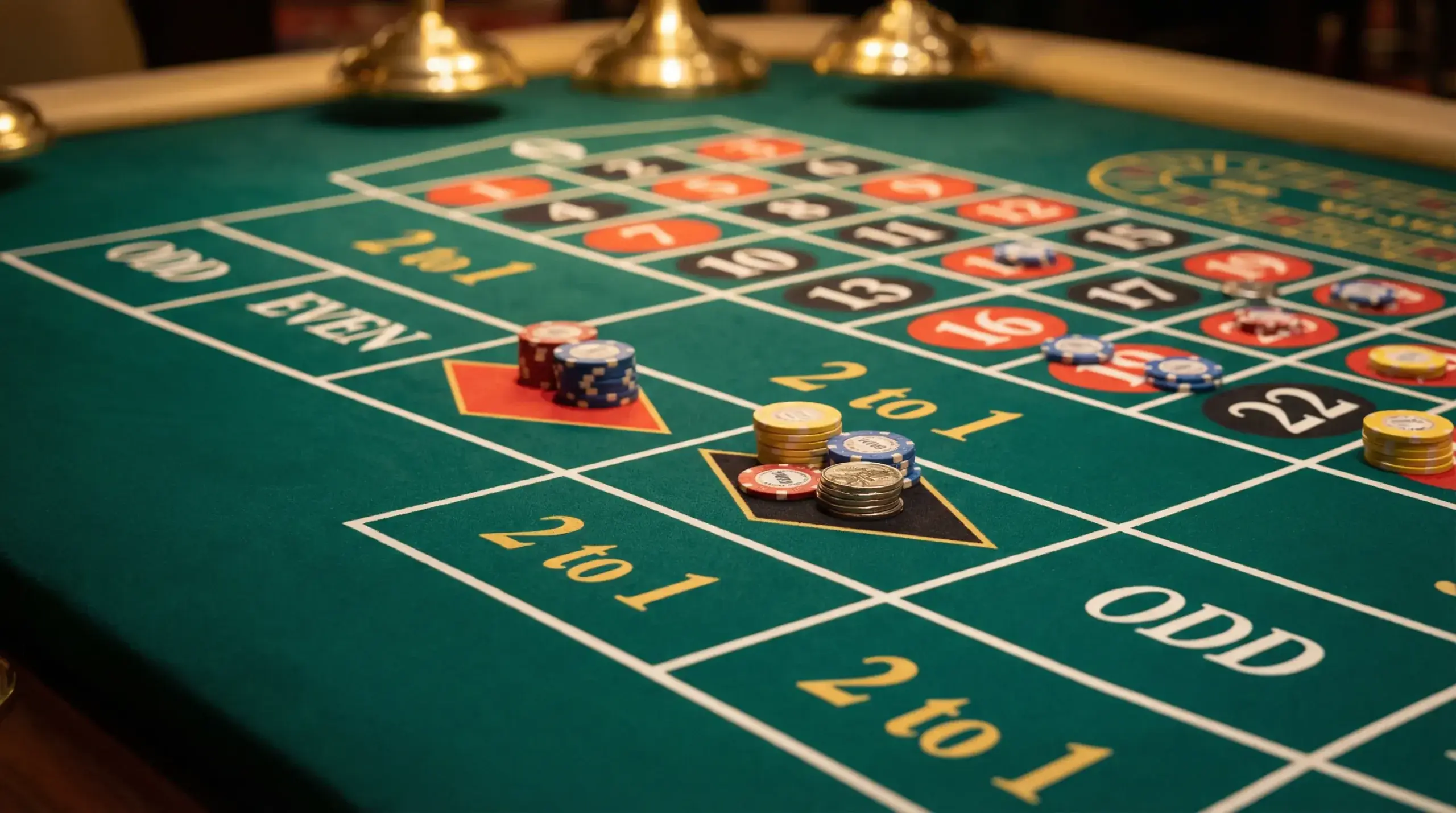
Outside bets occupy the areas surrounding the numbered grid on the roulette layout. These wagers cover large groups of numbers simultaneously — half the wheel on even-money bets, a third on dozens and columns. The frequent wins they provide come at the cost of modest payouts. For players who prefer steady action over dramatic swings, outside bets form the foundation of sustainable roulette play.
The mathematics favour patient, conservative approaches. Outside bets win more often than they lose in isolation, though the zero pocket ensures overall negative expectation. A red bet wins 18 times out of 37 spins on average — nearly half. This frequency sustains session length and reduces variance compared to inside betting, though the house edge applies identically to every wager type.
At non-GamStop casinos, outside bets function according to standard roulette conventions. This guide explains each outside bet category, the odds and payouts involved, and strategic considerations for players who find outside betting suits their style and bankroll management preferences.
Even-Money Bets
Three even-money bet types exist: red or black, odd or even, high or low. Each covers exactly 18 of the 37 numbers on a European wheel, paying 1:1 when your selection hits. Bet 10 pounds on black, win 10 pounds plus your stake if any black number appears. The simplicity appeals to beginners and experienced players alike.
Red covers numbers 1, 3, 5, 7, 9, 12, 14, 16, 18, 19, 21, 23, 25, 27, 30, 32, 34, and 36. Black covers 2, 4, 6, 8, 10, 11, 13, 15, 17, 20, 22, 24, 26, 28, 29, 31, 33, and 35. The distribution is not intuitive — memorising which numbers are which colour requires familiarity, though the table layout marks them clearly.
Odd and even bets function identically in structure. Odd covers 1, 3, 5 through 35. Even covers 2, 4, 6 through 36. High covers 19 through 36; low covers 1 through 18. Zero belongs to none of these categories, which creates the house edge — 18 winning positions versus 19 losing positions (including zero) on each even-money bet.
Winning probability on even-money bets is 18/37, or approximately 48.65%. The slight shortfall from 50% represents the house edge. Over a thousand bets at 10 pounds each, expected loss approaches 270 pounds — the 2.7% edge applied to 10,000 pounds total wagered. French roulette with La Partage reduces this by returning half of even-money bets when zero hits.
Recommended online casinos
- ZombillionBonus: Welcome Pack 250% up to £4000 + 200 FS · Payout speed: 1-3 business days
- BeOnBetBonus: 100% up to €500 + 100 FS · Payout speed: 1-3 business days
- AmunbetBonus: Join now and get 450% up to 2,700 GBP + 450 FS · Payout speed: 1-3 business days
- Revery PlayBonus: 100% up to€1,000+ 100 FS · Payout speed: 1-3 business days
- NightWinBonus: £900 + 400 free spins · Payout speed: 1-3 business days
- ChanzeBonus: Slots Welcome Bonus #1 200% up to €500 · Payout speed: 1-3 business days
- SlotoSportBonus: 500% up to £ 10 200+ 777 FS · Payout speed: 1-3 business days
Dozen Bets
Dozen bets cover twelve consecutive numbers in three groups: first dozen (1-12), second dozen (13-24), and third dozen (25-36). The payout is 2:1 — bet 10 pounds, win 20 pounds plus your stake if any number in your selected dozen appears. Winning probability is 12/37, approximately 32.4%.
The higher payout compared to even-money bets reflects the reduced coverage. You win less often but collect more when you do. Expected value remains identical — the 2.7% house edge applies whether you bet on 18 numbers at 1:1 or 12 numbers at 2:1. The choice between bet types is stylistic rather than mathematical.
Dozen betting appeals to players seeking middle ground between even-money frequency and inside bet payouts. Winning roughly one in three spins provides reasonable action density while delivering more satisfying individual returns than the smaller even-money wins. Sessions feel more eventful without the extended losing streaks common in inside betting.
Combining two dozen bets covers 24 numbers — nearly two-thirds of the non-zero outcomes. This hedging approach wins more frequently but at reduced net return when only one dozen hits. If both selected dozens miss, the loss doubles. Some players prefer concentrated single-dozen bets; others spread coverage for frequency.
Column Bets
Column bets cover twelve numbers running vertically through the layout rather than in consecutive sequence. The first column contains 1, 4, 7, 10, 13, 16, 19, 22, 25, 28, 31, 34. The second column holds 2, 5, 8, 11, 14, 17, 20, 23, 26, 29, 32, 35. The third column comprises 3, 6, 9, 12, 15, 18, 21, 24, 27, 30, 33, 36.
Payouts and probabilities match dozen bets exactly: 2:1 returns with 12/37 winning probability. The mathematical function is identical; only the specific numbers covered differ. Players choosing between dozens and columns base decisions on superstition, pattern preference, or simple variety rather than odds considerations.
Column distribution creates unequal colour coverage. The first column contains six red and six black numbers. The second column also balances evenly. The third column holds eight red and only four black numbers. This imbalance sometimes influences players who want to combine column and colour betting, though no mathematical advantage exists.
Column betting positions appear at the bottom of the numbered grid, marked “2 to 1” on most layouts. Chip placement on these positions indicates your column selection clearly. As with dozens, covering two columns hedges for frequency at the cost of reduced effective returns when only one column hits.
Outside Bet Strategy Considerations
Outside bets suit conservative bankroll management. The high win frequency reduces variance, making session outcomes more predictable than inside betting allows. A player betting even-money positions experiences smaller swings, both positive and negative. This stability appeals to those who prefer entertainment value over jackpot chasing.
Session length extends with outside betting. The frequent wins recycle bankroll continuously, sustaining play through periods that would exhaust inside bettors. More spins mean more entertainment from the same starting funds, though more spins also mean more exposure to the house edge over time.
Bonus terms often penalise outside bets specifically. Many casino bonuses count outside bet wagers at reduced rates — perhaps 10% or 20% contribution toward wagering requirements. A 40x requirement with 10% outside bet contribution effectively becomes 400x. Players clearing bonuses should verify roulette bet type contributions before committing to outside-focused strategies.
Progressive betting systems typically operate on even-money positions. Martingale, D’Alembert, and similar progressions assume near-50% win rates that only even-money bets provide. While these systems do not overcome the house edge, players who enjoy systematic approaches find outside bets provide the structural foundation those systems require.
Steady Play for Extended Sessions
Outside bets provide roulette’s most approachable entry point. The concepts are simple, the odds are clear, and the results arrive frequently enough to maintain engagement. Players new to roulette often start with even-money bets before exploring inside options as they gain comfort with table mechanics.
The modest payouts disappoint players seeking dramatic wins. No outside bet delivers returns that transform sessions in single spins. The trade-off is sustainability — outside betting grinds rather than explodes, losing slowly rather than catastrophically. For some players this steadiness represents ideal entertainment; for others it feels insufficiently exciting.
Non-GamStop casinos present outside bets identically to any other roulette venue. The positions exist on every layout, the payouts follow universal standards, and the house edge applies consistently. Whether red or black, odd or even, dozens or columns — outside betting offers structured simplicity for players who prefer it over inside bet volatility.