 Available in GB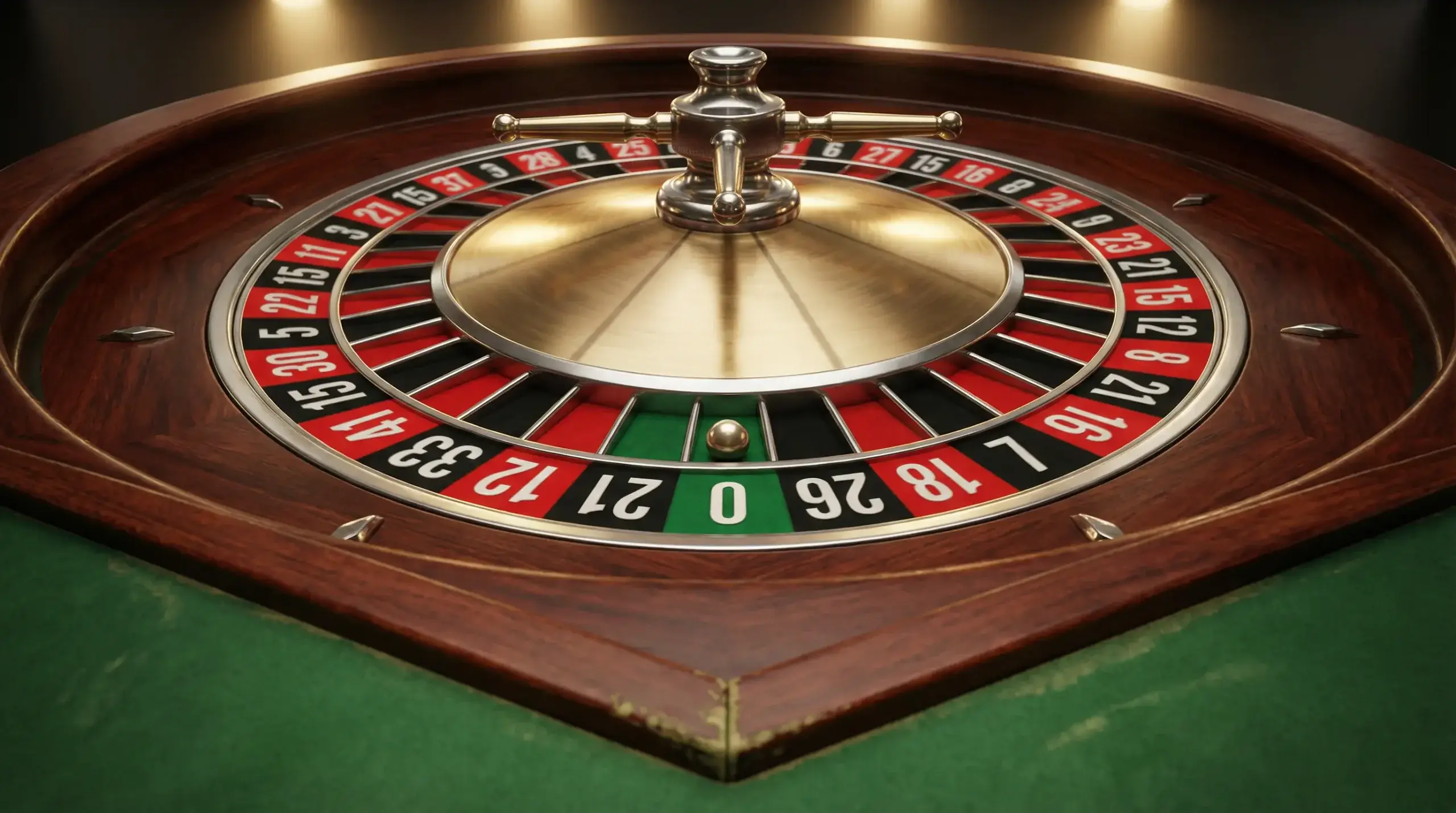
One zero makes all the difference in roulette mathematics. This single statement underpins everything that follows, and understanding why separates informed players from those who gamble blindly. European roulette — the original form of the game as it evolved in nineteenth-century casinos — features a wheel with 37 numbered pockets: 1 through 36 alternating between red and black, plus a single green zero. That zero is the source of the casino’s advantage. It is also, crucially, the only source of that advantage in European play.
When you compare European roulette to its American cousin, the distinction is not aesthetic or traditional — it is mathematical. American wheels add a second zero pocket, the double-zero or 00, bringing the total to 38 numbers. This seemingly minor addition nearly doubles the house edge. European roulette carries a house edge of 2.7%. American roulette rises to 5.26%. Over hundreds or thousands of spins, that difference compounds into substantial money.
For UK players accessing non-GamStop casinos, European roulette should be the default selection. These international platforms invariably offer both variants, and the choice sits entirely with the player. No regulation requires you to choose the mathematically inferior option, and no algorithmic randomiser cares which wheel you prefer. The only factor determining which edge you face is the table you join.
This guide examines European roulette in detail: the mathematical foundation of its house edge, the physical layout of the wheel, the betting options available, and how it compares to American and French variants. We will cover where to find European tables at non-GamStop casinos, including live dealer options, and discuss strategic considerations specific to single-zero play. The mathematics apply regardless of jurisdiction — a European wheel at a Curacao-licensed casino calculates odds identically to one at a UKGC-regulated site. What changes is player access, and for those registered with GamStop, international platforms provide that access.
Understanding why European roulette deserves your preference requires understanding probabilities, payouts, and expected value. By the end of this guide, the choice will be obvious — not because we have told you what to play, but because the numbers make the argument themselves.
Understand the maths behind your bets in roulette maths.
The Mathematics Behind European Roulette’s Edge
The house edge is not hidden — it is built into the payout structure. Understanding this requires examining how roulette payouts work and why they create an inevitable casino advantage.
A European roulette wheel contains 37 numbers: 1 through 36 plus a single zero. When you bet on a single number (a straight-up bet), you have one winning pocket out of 37 possibilities. Your probability of winning is therefore 1/37, or approximately 2.70%. If the payout matched true odds, a winning bet would return 36 to 1 (your original stake plus 36 units). Instead, roulette pays 35 to 1. That discrepancy between true odds and actual payout is the house edge.
Calculate the expected value of any £1 straight-up bet: you have a 1/37 chance of winning £35 (plus your stake back) and a 36/37 chance of losing £1. The expected value equals (1/37 × 35) + (36/37 × -1) = 0.946 – 0.973 = -0.027. That negative 2.7 pence per pound represents the house edge. Over time, the casino expects to retain 2.7% of all money wagered on European roulette, regardless of individual session results.
This edge applies to nearly every bet on the table. Red or black pays even money, but 18 winning numbers out of 37 (not 18 out of 36) means the probability is 48.6%, not 50%. The same mathematics govern dozens bets, column bets, odd/even, high/low — the zero ensures that every wager slightly favours the house. A few announced bets place chips covering the zero, effectively betting on rather than against it, but the edge still applies.
Compare this to American roulette’s 38-number wheel. A straight-up bet now has 1/38 probability, but payouts remain 35 to 1. The expected value calculation becomes (1/38 × 35) + (37/38 × -1) = 0.921 – 0.974 = -0.053. The house edge nearly doubles to 5.26%. Every other bet recalculates similarly: even-money bets face 18/38 (47.4%) probability instead of 18/37 (48.6%). That second zero erodes player expectations across the board.
Consider practical implications over an extended session. A player making 100 bets of £10 each on European roulette wagers £1,000 total. The expected loss is 2.7% of that, or £27. The same player at an American table expects to lose £52.60 — nearly double — with no change in playing style, bet selection, or anything else within their control. Over 500 bets, the difference grows to £135 (European) versus £263 (American). These are averages, not guarantees, but they represent the mathematical gravity pulling against every session.
The argument for European roulette is not stylistic or traditional. It is arithmetic. Given identical game speeds, identical bet sizes, and identical session lengths, European tables return more money to players than American tables. Not sometimes, not usually — always, when measured across sufficient volume. The only question is whether you prefer keeping more of your bankroll or donating it to the casino at accelerated rates.
The European Wheel — Layout and Number Sequence
Randomness is intentional — the wheel’s design ensures it. A European roulette wheel arranges its 37 numbers in a specific sequence that maximises apparent disorder while maintaining precise mathematical balance.
Looking at the wheel clockwise from zero, the sequence runs: 0, 32, 15, 19, 4, 21, 2, 25, 17, 34, 6, 27, 13, 36, 11, 30, 8, 23, 10, 5, 24, 16, 33, 1, 20, 14, 31, 9, 22, 18, 29, 7, 28, 12, 35, 3, 26. This arrangement was not chosen randomly — it serves several purposes that would confuse casual observers while ensuring fair play.
Red and black alternate perfectly around the wheel, with the single exception being the green zero. High numbers (19-36) and low numbers (1-18) distribute roughly evenly on each side of the wheel, as do odd and even numbers. No consecutive numbers appear adjacent to each other. The placement prevents any section of the wheel from being weighted toward particular betting categories that would create exploitable biases.
This layout differs significantly from American wheels, which arrange their 38 numbers in a completely different sequence and position the zero and double-zero directly opposite each other. The visual difference is immediately apparent to experienced players — European wheels show only one green pocket, while American wheels display two.
For most players, the wheel layout is academic. The ball will land wherever physics dictates, and memorising number sequences provides no practical advantage in play. However, certain betting strategies called sector bets or announced bets target physical sections of the wheel rather than numerical patterns on the table. Voisins du Zéro covers the 17 numbers surrounding zero on the wheel; Tiers du Cylindre covers the 12 numbers on the opposite side; Orphelins covers the remaining 8 numbers. Understanding that these bets relate to physical wheel position rather than table layout helps clarify their purpose.
Wheel quality matters at reputable casinos. Precision-engineered wheels undergo regular inspection to detect any biases that might develop through wear. Frets (the dividers between pockets) should be uniform, the bowl should be level, and the ball track should be free of imperfections. Licensed providers like Evolution maintain their equipment meticulously, but this is another area where playing at established casinos proves advantageous over unknown operators.
Bet Types Specific to European Roulette
Understanding the wheel layout matters not just for appreciating roulette’s design but for unlocking betting options unique to European tables. Announced bets add strategy layers beyond simple number picks. While standard inside and outside bets function identically across roulette variants, European tables — particularly live dealer versions — offer additional betting options rooted in the wheel’s physical layout.
Standard inside bets require no variant-specific explanation. Straight-up bets on single numbers pay 35:1. Splits covering two adjacent numbers pay 17:1. Streets covering three numbers pay 11:1. Corners covering four numbers pay 8:1. Six-line bets covering two adjacent streets pay 5:1. The probabilities adjust according to coverage, but the house edge remains constant at 2.7% across all inside bet types.
Outside bets cover larger sections of the table. Even-money bets (red/black, odd/even, high/low) each cover 18 numbers and pay 1:1. Dozens bets (1-12, 13-24, 25-36) each cover 12 numbers and pay 2:1. Column bets similarly cover 12 numbers arranged in vertical columns and pay 2:1. Again, the house edge holds at 2.7% regardless of which outside bet you choose.
The announced bets or call bets are where European roulette distinguishes itself. These wagers target sections of the physical wheel rather than patterns on the betting layout, and they require familiarity with the wheel sequence described earlier.
Voisins du Zéro (neighbours of zero) covers the 17 numbers on the section of the wheel surrounding the zero pocket: 22, 18, 29, 7, 28, 12, 35, 3, 26, 0, 32, 15, 19, 4, 21, 2, 25. The bet requires 9 chips placed as a combination of splits and corners. It covers nearly half the wheel physically while targeting numbers near the zero.
Tiers du Cylindre (third of the wheel) covers the 12 numbers opposite zero: 27, 13, 36, 11, 30, 8, 23, 10, 5, 24, 16, 33. This bet uses 6 chips placed as splits, providing roughly one-third wheel coverage.
Orphelins covers the 8 numbers not included in Voisins or Tiers: 1, 20, 14, 31, 9, 17, 34, 6. This bet requires 5 chips — one straight up on 1 and four splits covering the remaining numbers.
Neighbours bets allow you to select any number and cover it plus the two numbers on either side of it on the physical wheel — a 5-chip straight-up wager covering a contiguous wheel section. Most interfaces offer a dedicated racetrack betting area that makes placing these announced bets straightforward.
These sector bets provide no mathematical advantage. The house edge remains 2.7% regardless of how you distribute your chips. What they offer is flexibility in targeting wheel regions, which some players find more engaging than standard number selection. Whether you use announced bets or stick to basic inside and outside wagers, the expected return remains identical.
European vs American vs French — Why It Matters
Small percentage differences compound into significant money over time. Choosing between roulette variants is not aesthetic preference — it is financial decision-making that affects every session you play.
European roulette’s 2.7% house edge provides the baseline for single-zero play. American roulette’s 5.26% edge nearly doubles the casino’s mathematical advantage. French roulette, when played with La Partage or En Prison rules, drops the edge to 1.35% on even-money bets. Each variant uses the same fundamental mechanics, but their mathematical properties diverge significantly.
Consider a concrete scenario: 1,000 bets at £5 each, totalling £5,000 in action. At European tables, expected loss equals £135. At American tables, expected loss rises to £263. At French tables with La Partage on even-money bets, expected loss drops to £67.50. The same betting volume, the same session length, the same player behaviour — yet the variant selection alone creates nearly £200 difference between worst and best cases.
French roulette deserves specific mention because its advantages are conditional. The favourable rules apply only to even-money bets (red/black, odd/even, high/low). When the ball lands on zero, La Partage returns half your even-money bet automatically; En Prison holds your bet for another spin, returning it fully if the next spin wins. Inside bets and other outside bets gain nothing from these rules. If your preferred strategy involves inside bets, French tables offer no improvement over European ones.
Availability also factors into variant selection. European roulette is ubiquitous — virtually every casino offers it. French roulette with proper La Partage implementation is less common, and not every table marketed as French Roulette actually applies the beneficial rules. Check before playing. American roulette appears at many international casinos because of its popularity in certain markets, but no strategic reason exists to choose it over European alternatives.
When should you choose European over French? When La Partage or En Prison is not available, or when you prefer inside bets where the rules provide no benefit. When should you choose French? When the rules apply and you are making even-money wagers. When should you choose American? Frankly, never — unless the European table is unavailable and you are determined to play regardless. Even then, consider whether waiting for a European table might be the wiser choice.
The mathematics admit no debate. Given the option, European or French roulette dominates American roulette in every measurable way. Your bankroll will reflect your variant choices over time.
Finding European Roulette at Non-GamStop Casinos
Do not assume — verify the wheel has exactly one zero pocket. While European roulette dominates the international market, American tables appear at many casinos, and game labelling is not always clear. A moment of verification prevents playing the wrong variant.
Most non-GamStop casinos categorise their roulette offerings by variant. Look for explicit European Roulette labels in game lobbies. Reputable providers like Evolution and Pragmatic title their games clearly: European Roulette, Auto-Roulette European, Speed Roulette European. When a game is simply labelled Roulette without qualification, check before playing — open the game information panel or rules section to confirm the wheel type.
Software providers handling RNG (non-live) roulette similarly label their games. NetEnt’s European Roulette, Microgaming’s European Roulette Gold, Playtech’s Premium European Roulette — established developers maintain clear naming conventions. Lesser-known providers may be less consistent. If uncertainty exists, the game rules or paytable will specify whether the wheel contains 37 or 38 numbers.
In live casino lobbies, visual confirmation is straightforward: look at the wheel itself. European wheels display a single green zero pocket; American wheels show both 0 and 00. Before placing bets, watch a few spins to confirm. The camera angles provided by major streaming providers like Evolution make this verification easy.
Some casinos bury their game selection under generic categories. A Table Games section might list roulette variants separately or lump everything together. Navigate to Roulette-specific filters where available, or search for European explicitly. If a casino makes finding the right variant difficult, consider whether that operator values player experience or merely hopes you will settle for whatever loads first.
Provider-specific game titles worth seeking include Evolution’s Immersive Roulette (European rules with cinematic presentation), Pragmatic’s European Roulette, and any Auto-Roulette variant explicitly marked European. Lightning Roulette uses a European wheel despite its modified payout structure. When exploring unfamiliar casinos, sticking to major providers reduces the risk of encountering mislabelled or non-standard games.
Live European Roulette Options
Live tables bring European roulette’s elegance to your screen. The combination of a physical wheel and real-time dealer interaction elevates the standard variant into something approaching genuine casino atmosphere, and the single-zero format remains the foundation of every reputable live roulette offering.
Evolution Gaming’s European Roulette serves as the industry standard. Available at virtually every casino offering Evolution’s live suite, these tables feature professional dealers, multiple camera angles, and the clean interface that defines the provider’s output. Tables run continuously with betting limits typically ranging from £1 to £5,000 on outside bets, though specific limits vary by casino. The European wheel is presented clearly, with camera angles that confirm its single-zero configuration throughout play.
Immersive Roulette deserves special mention. This Evolution product uses European rules while adding cinematic production: over 200 video sequences, slow-motion ball tracking, and close-ups as results are determined. The game appeals to players who appreciate visual presentation alongside solid mathematics. Underneath the polish, it remains standard European roulette with identical odds.
Speed Roulette (European) compresses the betting window while maintaining single-zero rules. For players who find standard live tables too slow, Speed variants deliver approximately double the spins per hour without sacrificing the favourable house edge. The wheel is identical; only the pace changes.
Auto-Roulette variants remove the human dealer while retaining physical European wheels. Pneumatic ball release, continuous spinning, and automated result determination allow these tables to run around the clock with minimal downtime between spins. Minimums tend to be lower than dealer-staffed tables, making Auto-Roulette European accessible to players with smaller session budgets.
Pragmatic Play offers comparable European table options. Their standard European Roulette, Mega Roulette (European wheel with multipliers), and Speed Roulette all use single-zero configurations. While Pragmatic’s studio production does not quite match Evolution’s premium offerings, their European tables are mechanically identical and often feature competitive betting limits.
Other providers including Ezugi and Vivo Gaming maintain European roulette tables for non-GamStop casinos. These smaller operations typically offer lower limits and quieter tables, which suits some players perfectly. The wheel mathematics do not change regardless of which studio streams the game — only the presentation and surrounding experience differ.
Strategic Approaches for European Roulette
Any strategy performs better against a smaller house edge. This fundamental truth makes European roulette the superior platform for whatever betting approach you prefer, whether that involves progressive systems, flat betting, or intuitive play.
The Martingale system — doubling bets after losses to recover previous losing wagers — operates identically on any roulette variant but drains bankrolls faster against larger edges. A Martingale player at European tables faces the 2.7% edge on every bet in their progression sequence. The same player at American tables pays 5.26% on every bet. Over the hundreds of wagers that extended Martingale sessions require, that difference accumulates substantially. The system remains mathematically flawed regardless of variant, but it fails less expensively at European tables.
Flat betting — wagering the same amount on every spin regardless of previous results — is the most mathematically defensible approach. Your expected loss is simply your bet size multiplied by the number of bets multiplied by the house edge. A player making 100 flat bets of £5 at European tables expects to lose £13.50. The same session at American tables costs £26.30 in expected terms. No betting system eliminates the edge; flat betting simply makes it transparent and manageable.
Bankroll calculations should account for the European house edge specifically. A session bankroll of 50 times your average bet provides reasonable protection against normal variance at European tables. If your bets average £10, a £500 session bankroll allows for standard fluctuations while maintaining adequate runway. The lower house edge means this bankroll lasts longer on average than it would at American tables, providing more entertainment per pound deposited.
Session length expectations depend on pace. RNG European roulette allows rapid play — potentially hundreds of spins per hour if you choose. Live European tables average 60-80 spins per hour, enforcing a natural tempo. Plan your sessions around both available time and bankroll. A £200 budget supporting £5 average bets allows roughly 40 units of play before expected depletion — perhaps an hour at live tables, or mere minutes at rapid RNG pace.
No strategy overcomes the house edge in the long run. What European roulette provides is a mathematically favourable environment compared to alternatives. Your chosen approach — whether systematic or intuitive — operates more efficiently against a 2.7% edge than a 5.26% edge. The wheel does not care about your system; it cares only about physics. Your task is to ensure that physics works against the smallest possible mathematical disadvantage.
The Default Choice for Informed Players
When given the choice, mathematics makes the decision obvious. European roulette should be the default selection for any player who understands probability, expected value, and the long-term implications of house edge differences.
This is not opinion or preference — it is arithmetic. A 2.7% house edge returns more money to players than a 5.26% house edge. The difference is not marginal over extended play; it is substantial. A player wagering £10,000 cumulatively at European tables expects to lose £270. The same volume at American tables costs £526. That £256 difference buys nothing except a second zero pocket that serves only the casino’s interests.
Non-GamStop casinos present UK players with choices that UKGC-regulated platforms also offer. European roulette is available everywhere. American roulette is available everywhere. The question is not access — it is selection. Players who choose American tables at international casinos make the same mathematical error they would at domestic ones. The licensing jurisdiction is irrelevant to the wheel’s physics.
French roulette with La Partage offers even better odds on even-money bets, and where available, it represents the optimal choice for that bet type. European roulette remains superior for inside bets and non-even-money outside bets. American roulette has no scenario where it represents an optimal choice given alternatives.
The argument concludes simply: if European and American tables sit in the same lobby, offering similar limits, similar dealers, similar experiences, there is exactly one reason to choose American — ignorance of the mathematical difference. Having read this guide, that reason no longer applies to you.
The wheel will spin. The ball will bounce. Physics will determine where it lands. Your job is to ensure that when those results arrive, they arrive against the smallest possible house advantage. European roulette provides that advantage. Choose accordingly.
Explore European roulette options on the roulettenotongamstopuk homepage.